Yes, if the air around the pool is kept warm enough. Reinforced PVC membrane is welded on site, and the weld, the rolls and the water that goes in during the job all depend on temperature. The month on the calendar doesn't. So an indoor pool can be lined in January, an outdoor pool can be lined under a heated tent, and an outdoor pool in the open air waits for spring.
The rule is about the air, not the month
SOPREMA puts the limit in plain words in its SOPREMAPOOL installation manual (our translation from the Spanish edition of June 2024):
Attention: do not install the PVC-P lining if the ambient temperature is below 10°C.
The same manual asks for two more things that winter makes harder. The rolls are stored in a dry place, protected from damp and weather, between 10 and 30°C. And the edges being welded have to be clean and dry, because moisture turns to steam under the hot air and leaves bubbles in the seam. Frost on a sheet, or condensation on a cold shell, is moisture.
If you want to see what the welder does at the seam itself, it's in our article on how membrane seams are welded and checked.
Three places the work can happen in a Canadian winter
| Where the pool is | What sets the date | What it means for you |
|---|---|---|
| Outdoors, open air | The weather: days and nights above 10°C, dry | The job is planned in winter and done when the season allows |
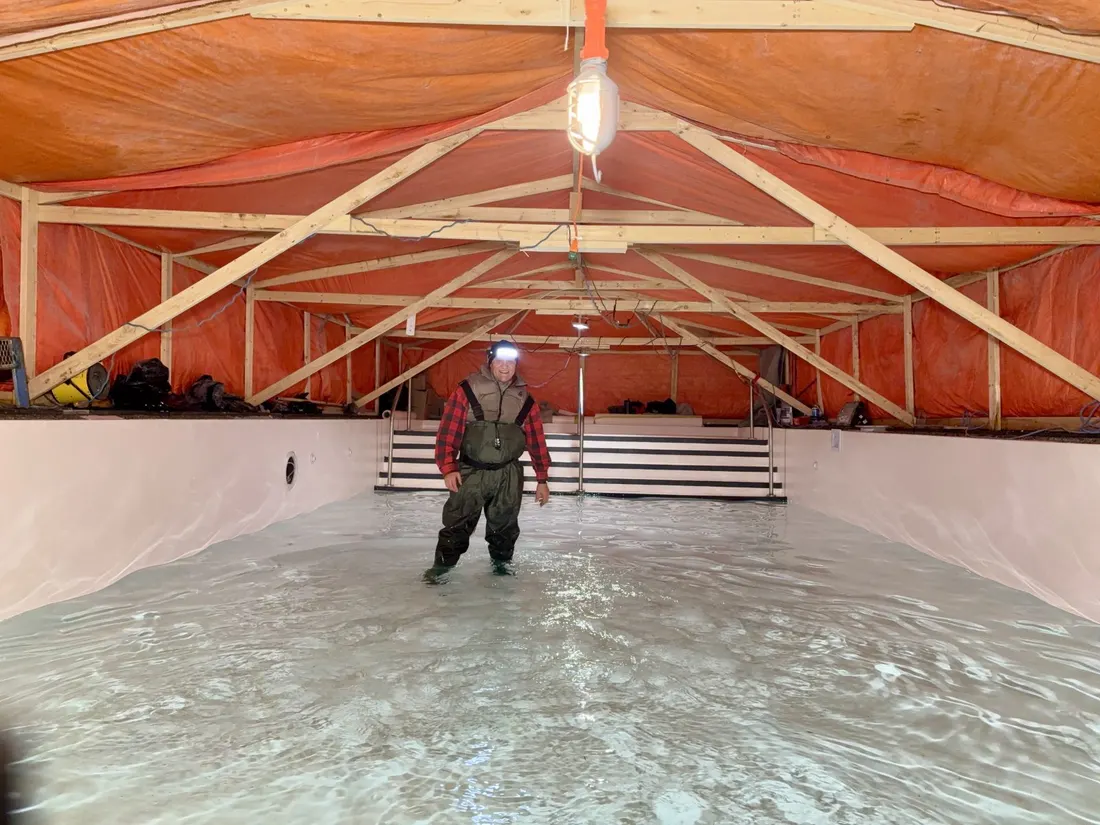
| Outdoors, under a tent | Whether the tent can be kept above 10°C, day and night, for the whole job | Possible in cold months, with a tent, heating and power on site |
| Indoors, in a heated hall | The hall: its air temperature, and the building being ready for the work | Not tied to the season at all |

Under a tent: what has to stay warm
A tent over an outdoor pool is a room built for the job. It keeps off rain, snow and wind, and it holds heat. These are the things inside it that the temperature rule really covers.
The rolls of membrane
Membrane brought in from a cold truck is cold through. Kept in the tent at working temperature, it is ready when the welding starts, and that follows the maker's 10 to 30°C storage range.
The air and the old surface
Air at 10°C over a shell that froze last week can still leave a wet film on the concrete. The underlay and the membrane go onto a dry surface, so the shell is given time to warm and dry before the first sheet goes down.
The water that goes in during the job
Most owners don't expect this one. According to the SOPREMA manual, the pool gets 40 to 60 cm of water before the skimmer, returns and lights are fixed to the walls, so the membrane settles with the right tension and without folds. Then the fittings go on and the pool is filled completely. On a winter job that water sits in the tent for days, and it can't be allowed to freeze.
The heater
Whoever heats the tent has to keep in mind that it is an enclosed space. Health Canada's page on preventing carbon monoxide exposure says never to use kerosene, propane or oil space heaters in enclosed areas unless they are designed for indoor use, and never to run outdoor fuel equipment inside a tent. Two people welding all day under tarps breathe that air.
Indoor pools: the hall sets the date
An indoor pool lives in a heated room, so the 10°C rule is usually met before anyone arrives. That makes winter a good time for indoor pools in houses, and for the condo, resort and spa pools on our page about membrane for commercial pools.
Two details still come from the cold outside. The SOPREMA manual warns that a difference between the temperature of the ground and of the pool can cause condensation between the structure and the membrane, and recommends letting that moisture drain from the lowest point of the pool instead of letting it sit there. In some countries this is required, so national rules come first. And a warm indoor pool has a ceiling of its own: RENOLIT's FAQ for pool professionals gives 32°C as the maximum operating water temperature for its membrane, and up to 35°C when it was pre-tensioned correctly during installation. Worth knowing if your indoor pool is kept warm for therapy or for small children.
We have worked through winters before

The second to last pool we lined before moving to Canada was a thermal spa that had to open by New Year's. We worked 43 days straight without a day off, and it opened on time. That job, and a few others, are on our About page. A pool in winter isn't new to us. What we look at first is where your pool is, and whether its air can be kept warm long enough to do the work properly.
If the pool waits for spring
For most outdoor pools in Canada the membrane goes in once the days stay warm. The months before that aren't wasted. A renovation with a new membrane starts with a review of the pool, and that can happen with the cover still on:
- where the pool is, indoors or out;
- the story of the pool so far, from the year it was poured to the last patch;
- its condition, with photographs from last season if you have them;
- when you would like the work to begin.
Send that through the estimate request and we reply within three days with when the estimate will be ready. Choosing the membrane and the colour happens in the same months, with sample books from RENOLIT, Poolside by CGT and SOPREMA. Until then, a pool that is full and closed is safe, as our article on closing a membrane pool for winter explains.
Short questions owners ask in November
Can membrane go over an outdoor pool in November or March?
Only on days when the air on site stays above 10°C for the whole job, or under a tent heated to that. A cold night in the middle of the job matters as much as the day it starts.
Does the pool have to be filled straight after the membrane goes in?
Water goes in while the job is still running: 40 to 60 cm before the wall fittings are fixed, then the rest once they are on. After that the pool stays full, and an outdoor pool is closed for the winter like any other.