You can't order a colour of water. You choose the surface under it, and then the depth, the sky and whatever grows around your yard do the rest. So the best way we know to judge a membrane colour is to look at filled pools, and a sample only tells you part of the story.
These are four pools we lined ourselves, from the palest surface to the darkest. We describe only what the photographs show.
Four surfaces, four kinds of water
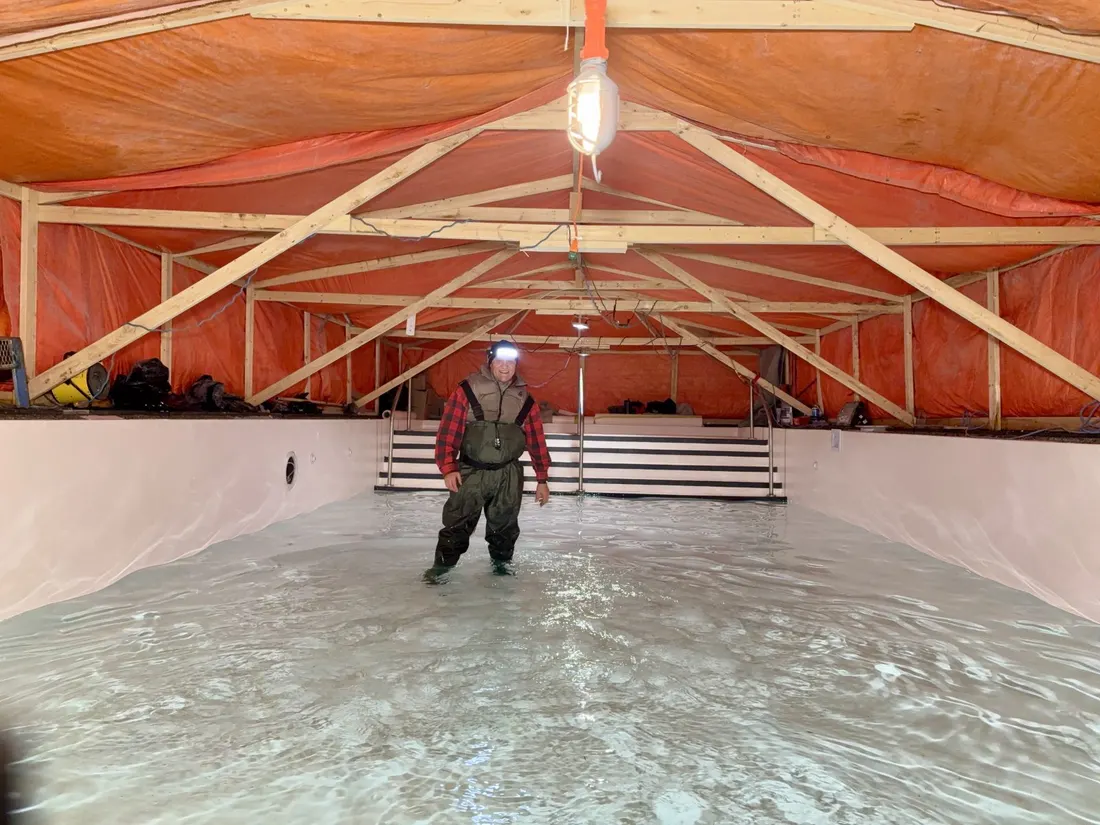
White membrane

On white, the water hardly has a colour in the shallow part. It only starts to look blue as it gets deeper toward the far end. You also see everything on the floor from the deck, which is why a public pool with a lifeguard chair is a natural home for it.
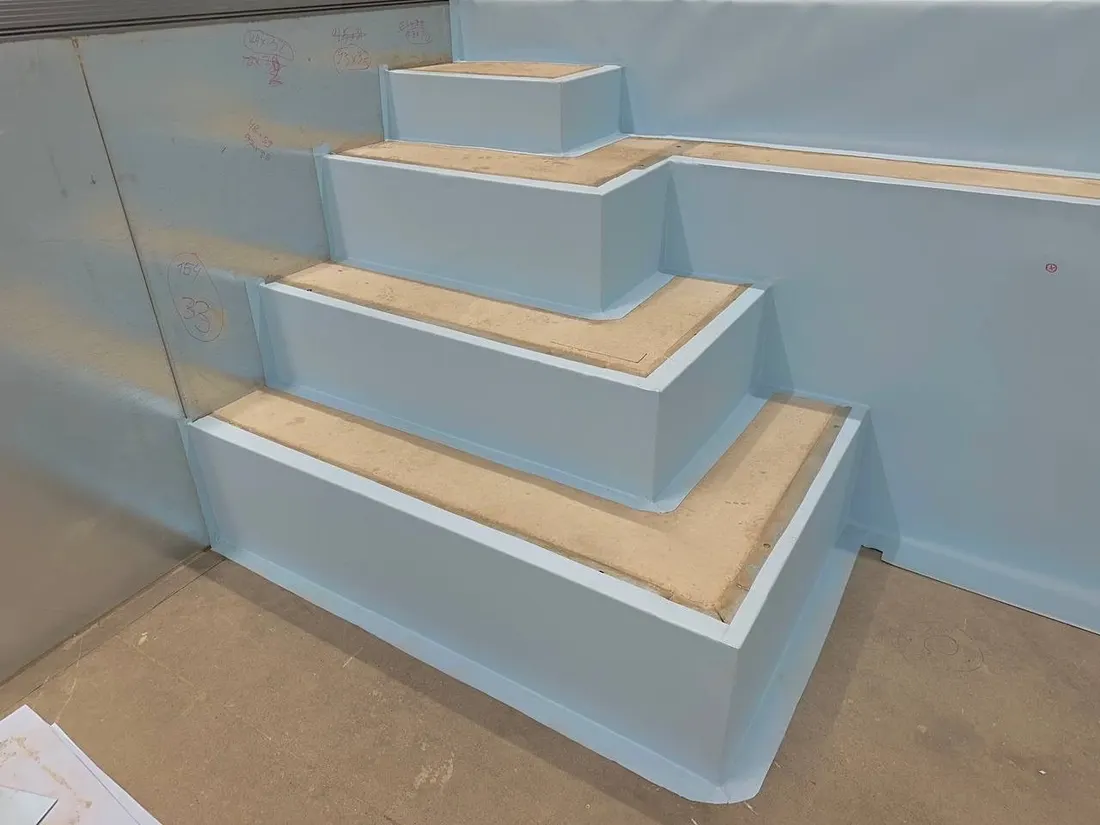
Light blue membrane

This is the colour most people picture when they think of a pool. In this one, under electric light, the water reads as aqua, a little greener than the dry membrane on the wall above it. Compare the wall with the water in the picture and you can see how much the colour shifts.
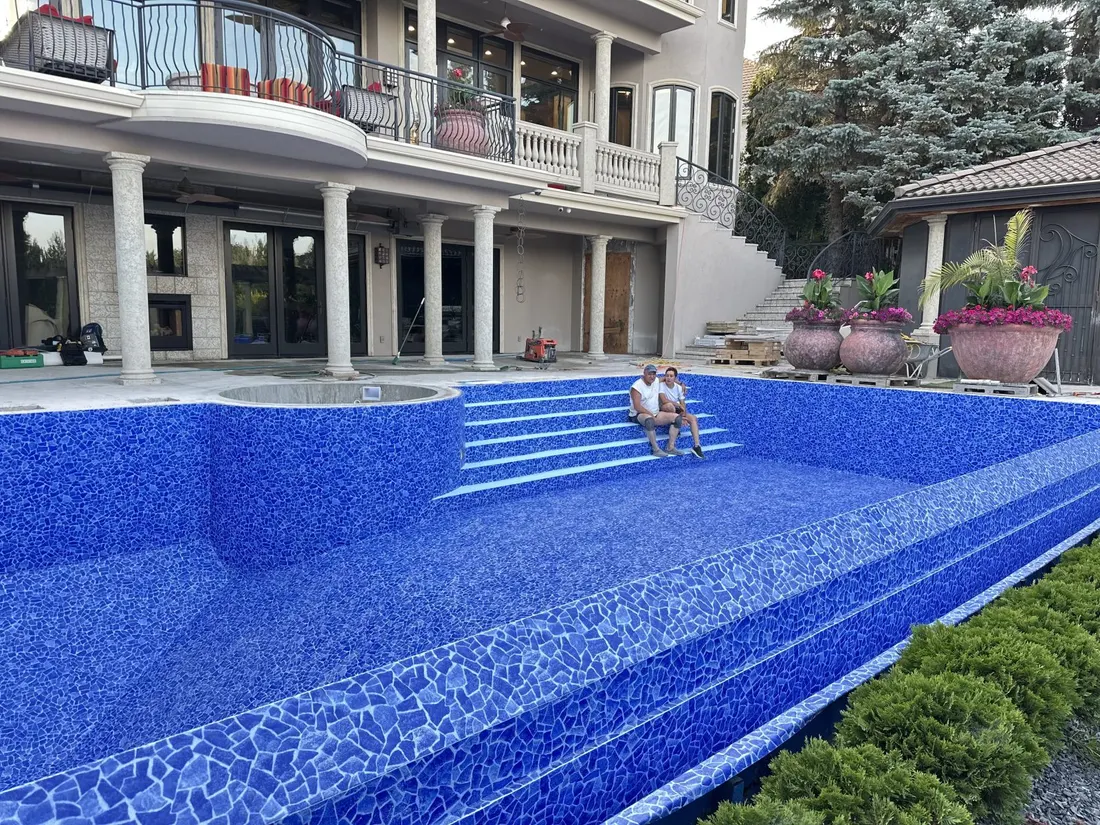
A blue mosaic print

A print goes darker as the floor drops away, and the pattern fades out of sight before the colour does. Near the camera you can count the squares. By the deep end they have become one deep blue.
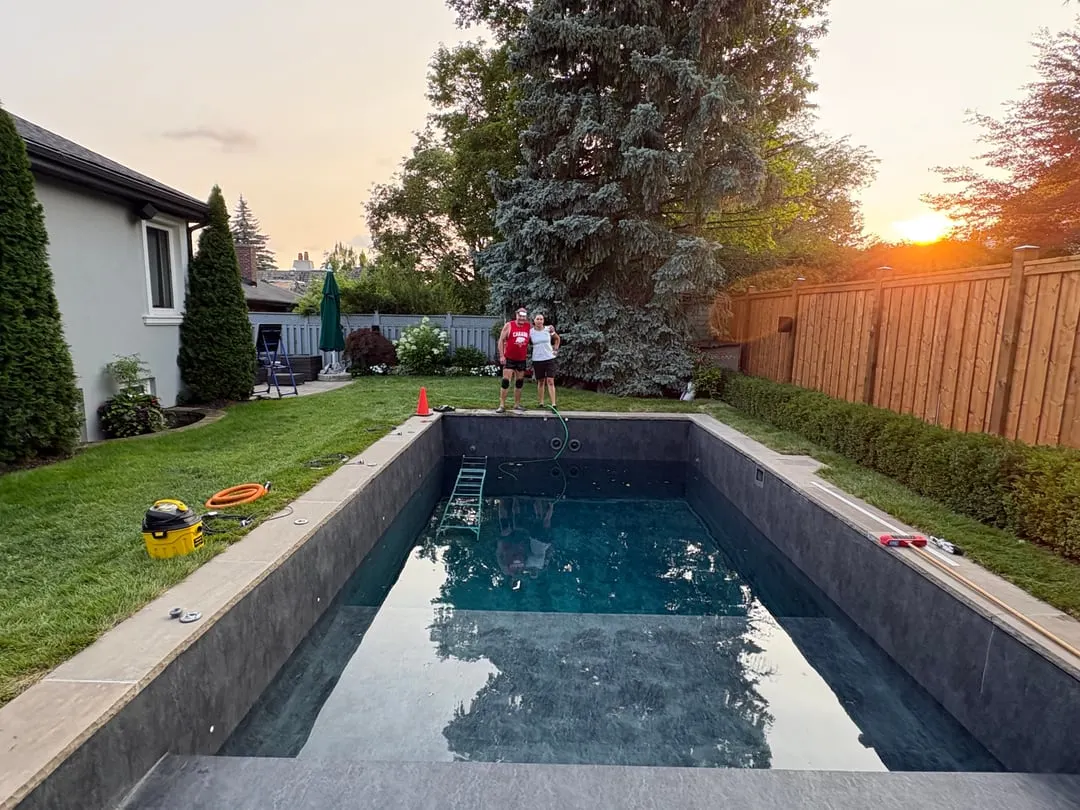
A dark stone print

This one surprises people. A grey sheet in your hand suggests grey water, and yet the deep part here is a dark green and teal. The surface also works as a mirror, so the trees and fence show up in it. The job is on our pool renovation page with more pictures, and the rest of our finished pools are in our gallery of finished work.
One pool at sunset and in daylight
Look again at the picture at the top of this article and at the dark pool just above. It's the same pool. At sunset the water takes on the sky and the spruce standing over it, and the floor nearly disappears. In the other picture, taken in daylight, the green comes up from below.
So judge a colour by more than one photograph, and ask what time of day it was taken. A pool that gets sun all afternoon and one under big trees won't give you the same water from the same sheet. If you mostly swim after work, the evening picture is the one that counts for you.
What each colour shows in the years after
Colour also decides what you will notice when the water chemistry slips. RENOLIT sets this out in its instructions for installation and use of ALKORPLAN KOLOS. The numbers below are for that membrane, so ask for the sheet that goes with yours, as each maker publishes its own.
| Colour | What can go wrong | What RENOLIT asks for |
|---|---|---|
| Dark | Fades sooner than a light colour when the pool is over-chlorinated | Stabilised chlorine at 0.7 to 1.5 mg/l with pH 7.0 to 7.6 |
| Light | Too much bromine can turn the membrane brown, and it shows far more on a light surface | Bromine at 1 to 2 mg/l with pH 7 to 8 |
| Light | Copper in the water, together with some sunscreens, can leave yellow stains along the waterline | No chemicals containing copper. Mains water can carry traces too, so have it checked |
| Any colour | Warmer water makes the balance harder to control and can speed up colour loss | An automatic treatment system is strongly recommended, and with manual treatment, a record of the water values |
None of this should steer you away from a colour you like. It tells you what to watch. A family with a heated pool and plenty of sunscreen will want to keep an eye on the waterline of a pale pool. An owner who loves a dark one should be careful with the chlorine dose, in summer and when closing the pool for winter.
Plain colour or a print
RENOLIT's own article on choosing a pool colour divides its range the same way: plain colours in ALKORPLAN2000, printed designs in ALKORPLAN3000, and the choice left to your surroundings and your taste. There is one practical difference that a catalogue won't mention. A membrane is welded together on site from sheets, so your pool will have seams, and the surface decides how much you see them.

On a plain colour a seam is a clean line that you can find if you look for it. On a busy print your eye has much less to catch.

A print is also at its boldest dry, so don't judge it only from the sheet. On our first Canadian pool, in Winnipeg, the blue mosaic print looked this strong before a drop of water went in, and as the mosaic pool above shows, water deepens a print and softens its pattern. Its story is on the page about our pool renovation in Winnipeg.

Two details that only come up with welded sheets
The first is the batch. RENOLIT tells installers to use sheets from one manufacturing batch on any one plane, so the strips match each other. That's our side of the job, but it's a good reason to order the whole pool at once and not plan to add a section from a later delivery.
The second is whatever sits above the water. RENOLIT notes that the sun mainly works on horizontal parts the water doesn't cover, and names the first steps and overflow areas, and it asks for a product with strong UV resistance there. If your steps rise out of the water, mention it when you pick a colour. How we line treads, risers and ledges by hand is on our page about membrane on pool steps and benches.
Taking the sample book out to your yard
We have sample books from RENOLIT, Poolside by CGT and SOPREMA, and you can see what each maker offers on our membranes page. A sample can't show you the water, but it can settle a lot if you use it outdoors. Some things worth doing with one:
- Lay it on the coping or the deck stone you already have, and look at the two together.
- Stand it against the house at the hour you usually swim, not at noon on the kitchen table.
- Note what stands over the pool. Tall spruces or a wall of cedars will show in dark water much more than in pale.
- Take photos of your pool and yard from the house and from the far end, and send them along with the size of the pool.
If you already have two colours in mind, ask us which of our pools comes closest to each. Winter is a good time to do it, with the pool closed and nobody in a hurry.