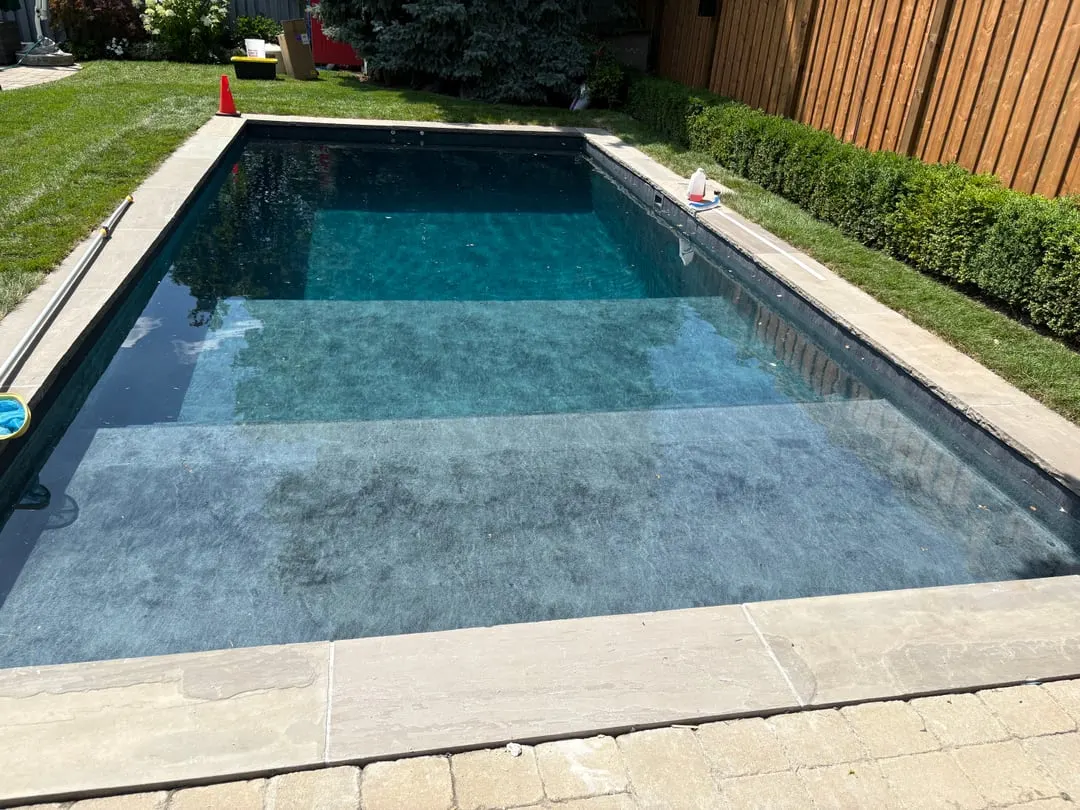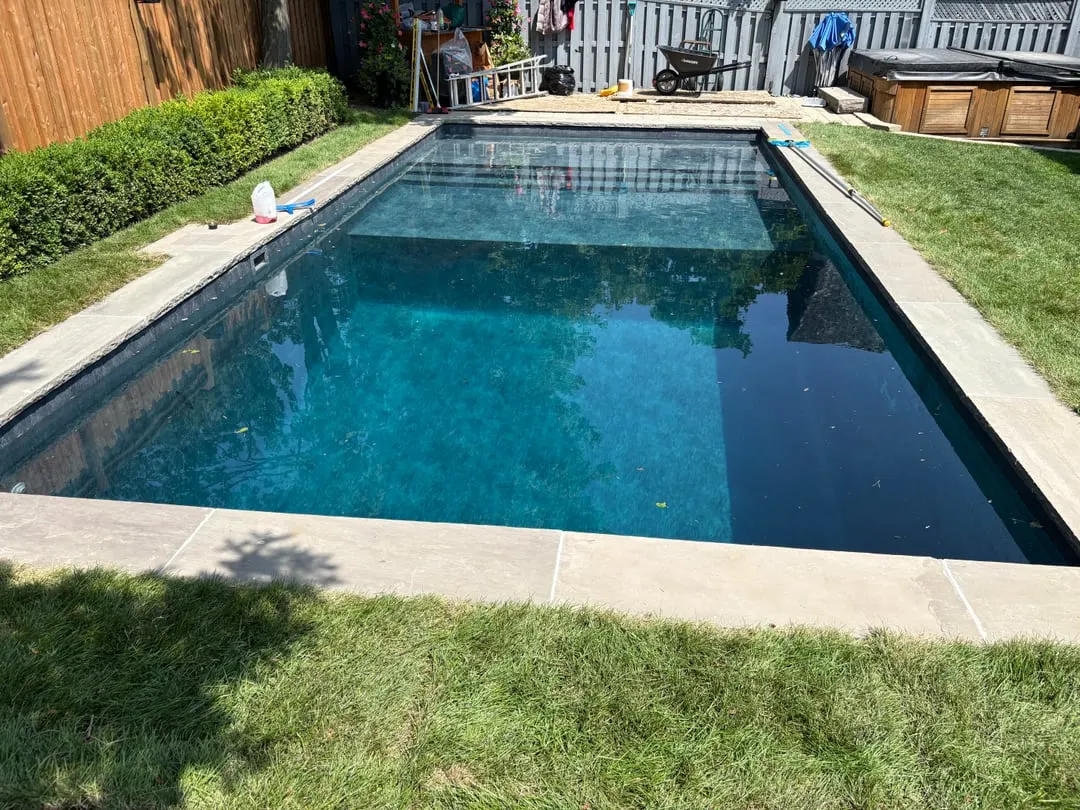
Most pool closing guides you will find this month were written for liner, plaster and fibreglass pools. They talk about water dropped well below the skimmer, sometimes below the returns, and a long list of products. A pool lined with reinforced PVC membrane is closed in much the same order, but the people who make the membrane publish their own numbers, and a few of them are stricter than the general advice.
This article goes through those numbers using SOPREMA's maintenance instructions for its SOPREMAPOOL membrane, one of the three brands we install, with a note from RENOLIT where it adds something. If your pool has a different membrane, the maker's own sheet is the one to follow, and it is worth finding before closing day.
The numbers that matter on closing day
| What | The number | Why it is there |
|---|---|---|
| When to start | Water below 13°C | The instructions recommend winterising from this water temperature, starting with a clean pool and clean accessories |
| Filtration after the shock | 24 hours | The shock goes in with the pool uncovered, then the filter runs a full day before winter products are added |
| Water level | 5 to 10 cm below the return jets, vacuum intake and skimmers | Enough to keep the fittings out of the ice, while the pool stays almost full |
| Active winterising | 2 runs of 1 hour a day, 8 hours apart | For owners who keep the filter working through winter instead of shutting it down |
| Metals when you refill | Iron or copper above 0.02 mg/L | Above this, the instructions recommend a metal sequestrant, because metals stain the membrane |
All five come from SOPREMA's maintenance instructions for reinforced membrane. If you want to know more about this membrane itself, our page on SOPREMA membranes shows the range we work with.
Closing day, in the order it is done
- Skim, brush and vacuum the pool, and wash the accessories you are taking out for the winter.
- Clean the waterline band. Use a soft sponge or a pool brush; the SOPREMA sheet warns against abrasive sponges, metal brushes and pressure washers on the membrane.
- Shock chlorinate with the cover off.
- Run the filter for 24 hours.
- Add the winterising products.
- Lower the water 5 to 10 cm below the return jets, the vacuum intake and the skimmers. Once the level is down, RENOLIT's FAQ for pool owners suggests cleaning the strip of lining that will stay above the water all winter, with clear water and a brush.
- Drain the pump, filter and pipes, so no water sits in them and freezes.
- Put floats in the water, then the cover.
If you would rather keep the filter running through the cold months, skip the draining of the equipment and set it to the two one-hour runs from the table. Either way, the instructions still ask you to check pH and alkalinity now and then, since the weather keeps changing the water under the cover.
Chemicals should never rest on the membrane
This is the step general closing guides leave out. A chlorine tablet left in the skimmer keeps dissolving after the pump is switched off. With no water moving, that strong solution settles low in the pool, around the main drain.
Stopping the filtration system can cause a high concentration of chemicals near the main drain, which may damage the lining.
SOPREMAPOOL maintenance instructions
So on closing day the skimmers are emptied of tablets before the pump goes off. A floating chlorine dispenser does not go under the cover either: the same instructions discourage them because they tend to stay in one spot and leave the chemicals concentrated there. Liquid or solid, no product should be poured straight onto the membrane.
Why a membrane pool never spends the winter empty
Draining a pool to keep frost away from it sounds careful, and it is the one thing the SOPREMA sheet rules out in plain words: never winterise by draining, never leave the pool empty through the winter. Without water over it, the membrane is open to sun and to anything that falls in. And if rain or a rising water table pushes water in between the membrane and the wall or floor behind it, the sheet says the membrane can shift and form folds.

That is the pool from our pool renovation in Winnipeg, between the last weld and the first water. On a new or renovated pool the filling starts as soon as the work is done, for the same reasons.
The water you let out has to go somewhere
Lowering a membrane pool by 5 to 10 cm is a small amount compared with dropping it below the returns, but it is still chlorinated water, and Ontario towns have rules for where it goes. The City of Mississauga, for example, asks owners to close the pool without polluting: chlorinated water sits for at least seven days without new chemicals, the chlorine reads zero before draining, it goes out by a hose to the curb and never onto a neighbour's property, and salt water goes to a sanitary drain inside the house. Check your own town's by-law before you open the valve.
Floats, ice and the walls
When the surface freezes, the ice presses on the walls, and on a membrane pool that means on the lining. The SOPREMA instructions answer this with floating devices left in the water under the cover, to reduce the ice pressure on the walls and the membrane. Spread them along the length of the pool rather than bunching them in the middle.

When the cover comes off in spring
Before you raise the water back to its summer level, walk around the pool and look at the part of the membrane that spent the winter above the water, then at what you can see under it:
- folds or soft bulges in the wall or floor that were not there in autumn;
- the welded seams, especially in corners and on the steps;
- the edges around the skimmer, the return jets, the lights and the main drain;
- stains along the old waterline.
Top up from the public water supply rather than a well if you can, since well water often carries iron, copper or manganese, and test the water for metals once the pool is full. Our close-ups of finished steps, drains and corners show what those places look like when the work is right. If a seam has opened or a fitting has started to leak, that is what our membrane repair covers: seams rewelded, the membrane cut out around a fitting and new patches welded in. Photographs of the spot are the best way to start.
Questions owners ask us in October
How far do I lower the water in a membrane pool for winter?
SOPREMA's instructions for its reinforced membrane say a few centimetres: 5 to 10 cm below the return jets, the vacuum intake and the skimmers. The pool stays almost full.
Should I drain the pool so the frost cannot hurt the membrane?
No. The same instructions say never to winterise a pool by draining it and never to leave it empty through the winter. The water is what protects the membrane.